Project · 2026 · Team build
DogTerm
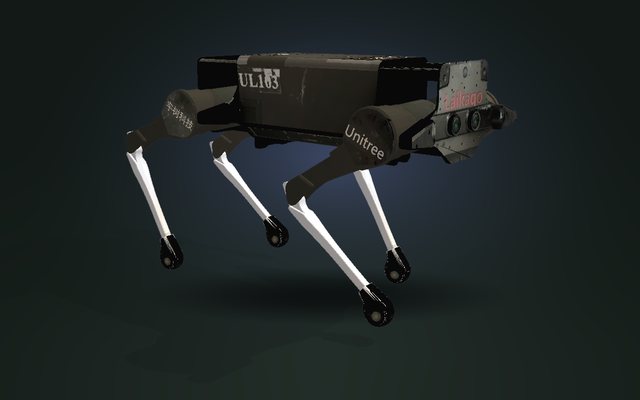
Recursive self-improvement for robotics. When a simulated robot dog loses a motor, an AI agent re-tunes how it walks, and an outer loop improves the agent’s own strategy.
- Type
- AI + robotics research
- Simulator
- PyBullet
- Year
- 2026
The idea
Robots break. A legged robot that loses torque in one motor usually falls over. DogTerm asks whether an AI system can not only adapt the robot’s gait after damage, but also improve the way it adapts: recursive self-improvement, tested on real physics.
Two levels of improvement
- Level 1: robot adaptation. A language-model agent proposes new values for the gait controller’s eight parameters (stride, step height, timing, stance, gains) and tests them in simulation until the damaged robot walks again.
- Level 2: harness evolution. An outer loop edits the agent’s own strategy (its prompt, search method, step size, memory and stopping rules), keeping only edits that measurably help.
- Guard rails. A deterministic critic blocks unsafe or leaky edits before any simulation runs, and comparisons use matched seeds, budgets and scenarios so results are fair.
- Honest evaluation. Separate development, validation and hidden test sets, with paired statistics and a pruning pass that reverts changes which don’t earn their keep.
What we found
In the main experiment (1,320 simulations, 504 model calls), the agent proposed six strategy edits. Their gains were smaller than the run-to-run noise, so the system correctly refused to claim an improvement. That is the point of building the evaluation carefully: it stops a self-improving loop from fooling itself.
Built with
- Python
- PyBullet
- NumPy
- SciPy
- Pydantic
- LLM agents